
UK Property Crash: When Will It Happen? The 18-Year Cycle Mapped for 2026
UK Property Crash:When Will It Happen? The 18-Year Cycle Mapped for 2026

Could the next UK property crash already be written in history? Or has the market entered an entirely new cycle?
Three significant turning points in Britain's property market, separated by approximately 16 to 18 years.
According to the 18-year property cycle, these dates may represent more than coincidence. They may reflect a recurring pattern of economic recovery, property speculation and eventual correction.
The theory, popularised by British economist Fred Harrison, pointed towards another potential turning point around 2025. Yet, as of October 2026, Britain has not experienced another nationwide property collapse comparable to 2008.
So, has the cycle been broken? Was COVID-19 the mid-cycle dip before another explosive period of growth? Or has the extraordinary economic intervention of recent years delayed or reset the cycle entirely?
At Dwelling & Manor, independent estate agents in Richmond upon Thames, we've examined the historical theory, current housing market data and what these possibilities might mean for homeowners across Richmond, Hampton, Teddington and Twickenham.
What is the 18-year property cycle?
The 18-year property cycle is an economic theory suggesting that property markets experience recurring periods of growth, speculation and recession, typically spanning approximately 18 years.
At its heart is a simple principle: land is finite, but the amount people are willing and able to borrow against it can expand considerably.
As an economy grows, mortgage lending increases, demand strengthens and property prices rise. Eventually, increasing prices and speculative investment can create conditions that become unsustainable.
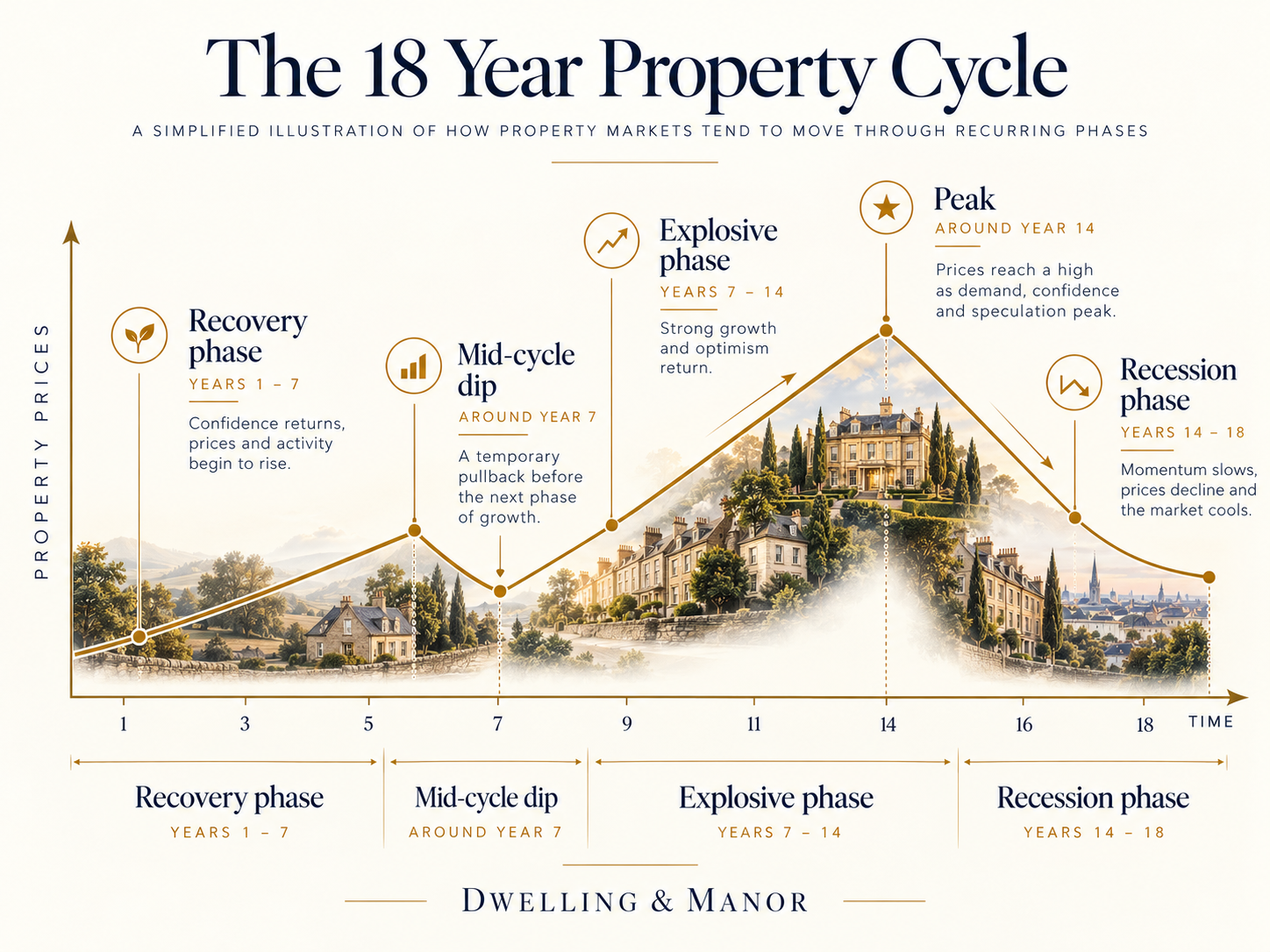
The traditional model is commonly illustrated through four main stages:
Recovery
Confidence returns after a downturn. Property prices stabilise and gradually increase.
Mid-cycle dip
A temporary slowdown interrupts growth before a potential new expansion.
Explosive phase
Credit, confidence and speculation accelerate, potentially culminating in a peak.
Recession
Economic pressures and softer demand may bring the expansion to an end.
The years shown are illustrative rather than fixed dates. Actual property markets rarely follow a predictable timetable.
Why is the mid-cycle dip so important?
One of the most interesting and often overlooked aspects of the 18-year property cycle is the mid-cycle dip.
Rather than experiencing uninterrupted price growth until the final crash, the theory suggests that markets can encounter a meaningful slowdown partway through their expansion.
Confidence weakens, transactions may decline and price growth can slow or temporarily reverse. Yet this doesn't necessarily represent the end of the cycle.
Under the traditional theory, the mid-cycle dip can be followed by a much stronger period of expansion, with rising investment, increased borrowing and renewed property speculation eventually creating the conditions for a significant correction.
Have we already experienced the final boom — or could it still lie ahead?
Has the cycle predicted previous UK property crashes?
Looking at Britain's post-war property history, the similarities are striking.
A major property boom reached a turning point amid inflation and economic instability.
The late-1980s housing boom peaked before falling prices and widespread negative equity.
The property market turned as the global financial crisis unfolded.
A possible turning-point window under different interpretations of the theory — not a confirmed forecast.
Fred Harrison predicted a property market peak towards the end of 2007 in an article published in The Guardian in April 2005.
The historical pattern is interesting, although far from conclusive. There are relatively few complete post-war cycles to compare, turning points are not precisely 18 years apart, and the theory remains debated among economists.
Nevertheless, it provides a useful framework for examining how credit, confidence and property prices interact.

Did COVID-19 disrupt the 18-year property cycle?
The pandemic created an economic disruption unlike anything Britain's modern housing market had previously experienced.
In 2020, economic activity contracted dramatically. Yet instead of a prolonged nationwide property price collapse, the market subsequently experienced remarkable growth.
The Bank of England reduced interest rates to 0.1%, the government introduced substantial financial support and a stamp duty holiday encouraged transactions. Meanwhile, changing lifestyles created additional demand for larger homes and outdoor space.
This unprecedented intervention creates four possible interpretations of where we stand in the property cycle today.
No single answer. Four competing scenarios.
These are possible readings of the theory, not predictions or investment advice.
COVID was the mid-cycle dip — and the explosive phase is still ahead
Perhaps the most intriguing possibility is that COVID acted as an extraordinary interruption within the wider property cycle rather than signalling its conclusion.
Although house prices did not experience a sustained national collapse, the pandemic temporarily interrupted economic activity, property transactions and normal market behaviour. Could this have performed a similar role to the traditional mid-cycle dip?
If so, Britain could now be approaching or entering the explosive phase of the cycle, potentially experiencing another period of significant property price growth before a later correction.
There is, however, an important complication. The timing does not neatly align with a conventional cycle measured from the 2007–2008 peak, and the subsequent property boom of 2020–2022 makes the interpretation less straightforward. Sustained acceleration in lending, transactions and prices would make this hypothesis more convincing; current national data has not yet demonstrated that.
COVID delayed and prolonged the existing cycle
Another possibility is that the traditional cycle remains intact, but its timing has been extended.
Government financial support, unusually cheap borrowing and intervention in the housing market may have prevented or postponed a correction that would otherwise have occurred sooner.
Under this interpretation, the cycle has not necessarily been broken. Its final turning point may simply have been pushed further into the future.
Could the expected downturn arrive in 2027, 2028 or 2029 instead? It's possible, but the theory cannot reliably identify an exact year.
COVID completely reset the property cycle
Major historical events, including wars and extraordinary economic disruptions, have altered the normal course of markets. COVID may have been significant enough to do something similar.
If the pandemic fundamentally changed borrowing behaviour, housing demand and economic conditions, the traditional 18-year timetable may no longer be a useful guide to the next turning point.
A new cycle may have begun, with a different starting point and potentially a very different timeline.
The explosive phase already happened
There is also a contrasting interpretation. Perhaps the rapid property price growth experienced between 2020 and 2022 represented an unusually early speculative boom.
Historically low borrowing costs, intense buyer demand and rapidly increasing prices could be viewed as characteristics of the explosive phase.
Under this scenario, the weaker market conditions seen since the rise in interest rates may already represent a correction.
Rather than waiting for a dramatic crash, Britain could be experiencing a prolonged period of subdued prices and gradual adjustment.
The crucial point is that all four interpretations remain hypotheses. None can be established simply by comparing dates on a historical chart.
Where is the UK property market in 2026?
The latest official figures provide a more measured picture than the headlines might suggest.
According to the HM Land Registry UK House Price Index, the average UK property price reached approximately £273,000 in July 2026, representing annual growth of just 1.4%.
London performed considerably more weakly, with average property prices falling 3.3% year-on-year.
Source: HM Land Registry UK HPI, July 2026. Provisional figures.
These figures do not currently resemble a widespread speculative property boom.
However, a correction does not always require a dramatic fall in headline prices. If property prices remain stagnant while wages and inflation rise, homes can become less expensive in real terms.
Britain could therefore be experiencing a gradual adjustment rather than an abrupt collapse. Alternatively, if borrowing costs fall and demand strengthens, another period of growth remains possible.
Very different markets.
What does the property cycle mean for Richmond upon Thames?
For homeowners in southwest London, understanding the national picture is only part of the story.
The London Borough of Richmond upon Thames remains one of London's most valuable residential property markets, but its different property types are not experiencing identical conditions.
According to the Office for National Statistics, the average property price in Richmond upon Thames stood at approximately £803,000 in July 2026, a decline of just 0.8% year-on-year.
By comparison, average London property prices fell 3.3% over the same period.
Richmond upon Thames house prices — July 2026
| Property type | Average price |
|---|---|
| Detached houses | £1,815,000 |
| Semi-detached houses | £1,192,000 |
| Terraced houses | £916,000 |
| Flats and maisonettes | £487,000 |
| All properties | £803,000 |
Source: ONS, Housing prices in Richmond upon Thames. Provisional July 2026 data.
Perhaps most interestingly, detached house prices increased by 2.4% over the year, while flats and maisonettes declined by 3.1%.
This suggests a more complicated picture than a single borough-wide average can reveal. Different housing types, locations, price brackets and buyer groups are responding differently to current market conditions.
Affordability, mortgage rates, outside space and tenure can all influence demand. For homeowners considering selling, these differences may be considerably more important than attempting to predict the precise end of an 18-year cycle.
Richmond, Hampton, Teddington and Twickenham: one borough, different property markets
A national property downturn does not necessarily affect every town or neighbourhood in the same way.
As independent estate agents operating throughout the London Borough of Richmond upon Thames, Dwelling & Manor examines local conditions alongside broader economic trends.
Estate agents in Richmond
Richmond's housing market encompasses Georgian townhouses, Victorian family homes, riverside apartments and period conversions. Demand can vary considerably between Richmond Hill, Richmond Green, North Sheen and the surrounding neighbourhoods.
Our Richmond team assesses local comparable sales, buyer demand and the individual character of each home to develop a considered pricing and marketing strategy.
Estate agents in Hampton
Hampton Village, Hampton Hill and the surrounding streets offer period cottages, family houses and larger detached properties. Bushy Park, the Thames and local rail connections can shape buyer preferences.
Our Hampton estate agency combines local property knowledge with professional photography, thoughtful presentation and owner-led service.
Estate agents in Teddington
Teddington's market includes Victorian terraces, Edwardian houses, riverside homes and contemporary apartments. Proximity to Teddington Lock, Bushy Park and the High Street can make a meaningful difference.
Our Teddington estate agents provide valuations and marketing advice informed by competition, buyer demand and each property's particular features.
Estate agents in Twickenham
From period houses around Twickenham Green and Strawberry Hill to modern apartments near Twickenham Station, the town includes very different homes and buyer budgets.
Our Twickenham estate agents help sellers understand how condition, tenure, competition and pricing influence achievable values.
Across all four locations, the message is consistent: the property cycle may influence the wider economy, but individual homes are ultimately valued within their own local market.
Will UK house prices crash in 2027, 2028 or 2029?
If the traditional 18-year property cycle remains relevant, the period between now and the end of the decade deserves attention. Yet several very different outcomes remain possible.
Improving mortgage affordability and renewed confidence could encourage further property price growth, potentially supporting the explosive-phase or prolonged-cycle interpretations.
Alternatively, Britain may experience several years of relatively stagnant prices, with inflation gradually adjusting property values in real terms.
A sharper downturn also remains possible if unemployment rises, mortgage availability deteriorates or the economy experiences another major shock.
No historical cycle can tell us precisely when the next property crash will happen or how severe it might be.
Should you sell your home before the next property crash?
The question facing homeowners is not simply whether another property crash will happen, but whether current market conditions, personal circumstances and the value of their individual property make selling the right decision.
Property markets have experienced significant downturns throughout history, but neither their timing nor their severity is inevitable.
For some homeowners, selling in today's market may be sensible. For others, holding their property for the longer term could be preferable.
At Dwelling & Manor, we believe informed property decisions should be built around real market evidence, local knowledge and individual circumstances, rather than attempting to perfectly time an economic cycle.
Our residential sales service combines best-in-class marketing, considered presentation, local expertise and a personal, owner-led approach.
Is another UK property crash coming?
The 18-year property cycle remains one of the most fascinating theories surrounding Britain's housing market. From the early 1970s to the late 1980s and the financial crisis of 2007–2008, the historical similarities are difficult to ignore.
But the extraordinary events of 2020 may have changed the timing, or even the structure, of the next cycle.
Was COVID the mid-cycle interruption before another explosive boom? Or have we already experienced the final peak?
Did government intervention prolong the cycle? Has the timetable been reset entirely? Only future market evidence will help distinguish between these possibilities.
For homeowners across Richmond, Hampton, Teddington and Twickenham, the most important consideration is not predicting an exact crash date, but understanding what their property could realistically achieve in the market today.
The property cycle, explained simply
What is the 18-year property cycle in the UK?
It is a theory that property markets move through recurring periods of recovery, a mid-cycle slowdown, stronger speculative growth and a correction. The timing varies and it is not a reliable calendar for predicting exact crashes.
Could COVID have been the mid-cycle dip?
It is one possible interpretation, because the pandemic interrupted economic activity and housing transactions. However, house prices did not experience a sustained national fall and the timing does not neatly fit a cycle beginning with the 2007–2008 peak.
Are Richmond upon Thames house prices falling?
The borough's provisional average price was £803,000 in July 2026, around 0.8% lower than a year earlier. Detached homes rose 2.4% while flats and maisonettes declined 3.1%, demonstrating why property type and location matter.
Research & sources
Fred Harrison, The Guardian, April 2005 · HM Land Registry, UK House Price Index, July 2026 · ONS, Housing prices in Richmond upon Thames · Bank of England, March 2020.
Market information correct as of 17 October 2026. The latest published house price figures used here relate to July 2026 and are provisional. The article explores economic theories and possible scenarios, not guaranteed market forecasts or financial advice.
Know your property's value.
Not just the headlines.
Whether you're considering selling or simply weighing up your options, discover what your home could achieve in today's market with considered, evidence-led local advice.